
A Global Red Scare: Anti-Terror Laws and the Return of Political Repression
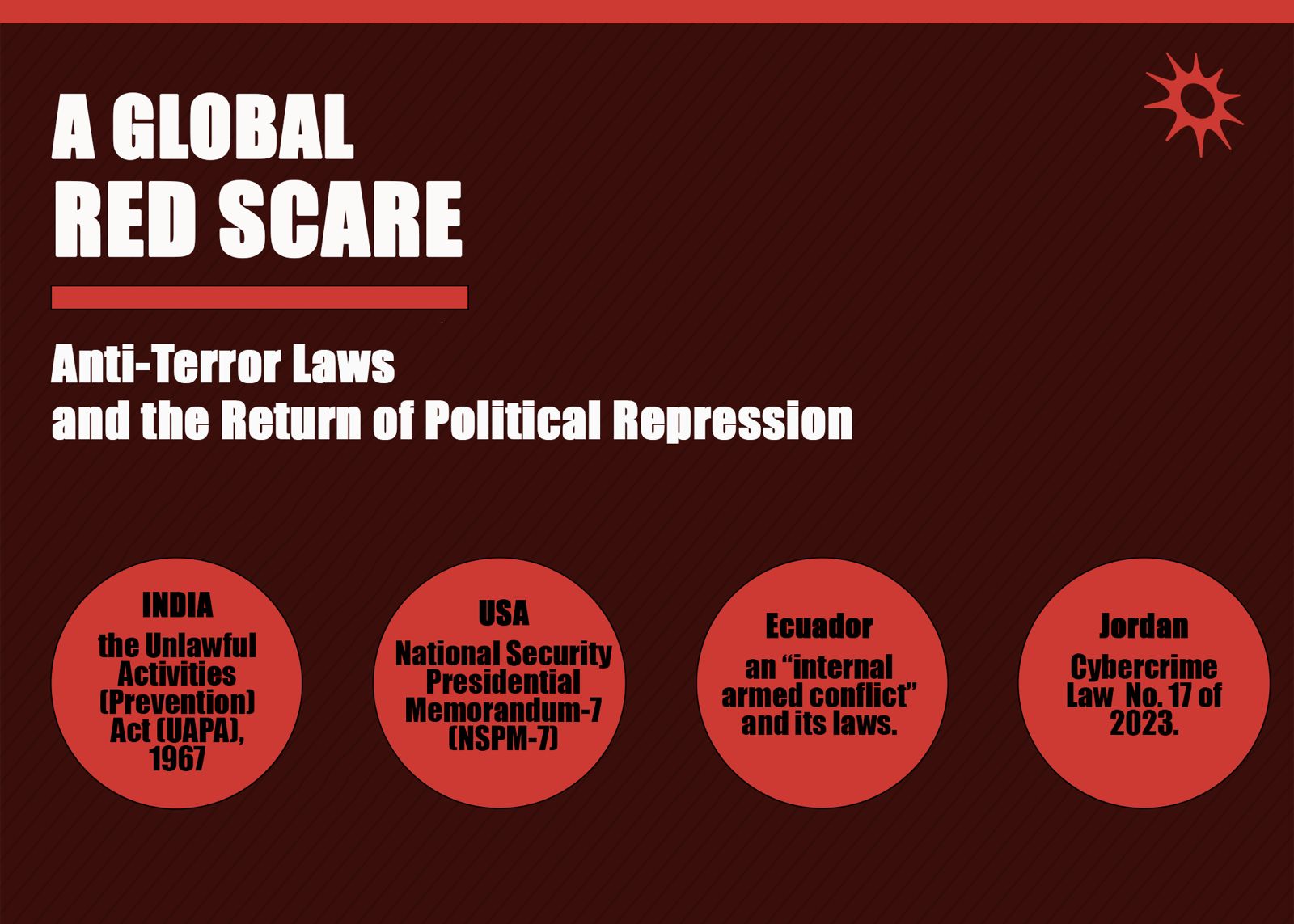
In a republic, an empire, an Andean security state, and a monarchy, the same law is spreading — one that treats political opposition itself as terrorism.
A parliamentary republic, an imperial power, a right-wing Andean government, and a monarchy share no region, no alliance, and no form of government. Between them, the same legal instrument is nonetheless spreading: statutes and decrees written in the language of “terrorism” and “national security” that treat political opposition itself as a threat to be policed. Far from coincidental, this convergence is a shared architecture whose purpose is to build a legal framework capable of designating entire organizations and broad movements as enemies of the state, and, through them, of dismantling the conditions in which people become capable of organizing at all.
India — the Unlawful Activities (Prevention) Act (UAPA), 1967. The UAPA was enacted to defend the “sovereignty and territorial integrity” of India, and its central offence, “unlawful activity,” reaches acts committed “by words, either spoken or written, or by signs.” What began as a regulatory law for banning associations was transformed in 2004, when — after the repeal of the Terrorist and Disruptive Activities (Prevention) Act (TADA) and the Prevention of Terrorism Act (POTA) — a dedicated terrorism chapter was folded in and absorbed their powers. The 2008 amendments broadened the definition of a “terrorist act” and lengthened detention, and the 2019 amendment empowered the government to brand individual people, and not only organizations, as terrorists. A law written about territory had become the state’s principal instrument for designating its opponents.
United States — National Security Presidential Memorandum-7 (NSPM-7). There is no federal crime of “domestic terrorism,” and in its place NSPM-7 directs federal law enforcement and the Treasury against a list of political “indicators,” including views it labels “anti-Americanism, anti-capitalism” and “anti-Christianity.” Because no underlying offence exists, constitutionally protected speech becomes the trigger for investigation, and the machinery that acts on it — the network of Federal Bureau of Investigation-led Joint Terrorism Task Forces and “fusion centers” — has surveilled racial-justice, environmental, and peace organizers.
Ecuador — an “internal armed conflict” and its laws. Since January 2024, President Daniel Noboa has governed through a declared “internal armed conflict,” designating some twenty-two groups as terrorists, deploying the armed forces for internal policing, and suspending constitutional guarantees across whole zones. In June 2025 this footing was hardened into legislation through a National Solidarity Law that authorized warrantless raids, lowered the threshold for lethal force, and shielded security personnel from prosecution, together with an Intelligence Law that created a centralized system empowered to intercept communications without a prior judicial warrant.
Jordan — Cybercrime Law No. 17 of 2023. Ratified by King Abdullah II in August 2023, Jordan’s Cybercrime Law expanded the previous framework from fifteen to forty-one articles and, beside genuine cyber-offences, criminalized vaguely defined speech — “fake news,” “provoking strife,” “undermining national unity,” “online assassination of personality” — in language broad enough that a prosecutor decides where criticism ends and crime begins.
For all their differences of legal tradition, these laws converge on a single technique, the elastic offence. India’s “unlawful activity,” the United States’ “indicator,” Ecuador’s “internal armed conflict,” and Jordan’s “undermining national unity” are each defined so broadly that their meaning is fixed by the official who applies them rather than by the text, which lets a single clause be stretched from an armed network to an entire trade union or mass movement. None of these instruments is new in kind. Each updates and absorbs an older apparatus of repression — the UAPA took in the powers of TADA and POTA, and Ecuador’s decrees extend a long series of states of exception — because the capitalist state revises and sharpens its repressive law in proportion to the threat it perceives to its own survival, escalating the legal machinery as its legitimacy weakens.
The purpose of these laws is not merely to punish individuals but to provide a framework capable of designating entire organizations and broad movements as security threats, and activists, protesters, journalists, and organizers are all swept up in that net. In India, the sixteen lawyers, academics, and poets known as the Bhima Koregaon 16 were jailed for alleged links to a banned communist party, and the UAPA, a statute built for terrorism, was turned against the Communist Party of India (Marxist), or CPI(M), leader P. Jayarajan on a charge of conspiracy to commit a terrorist offence — anti-terror law repurposed to strike an organizer. In Ecuador, the terrorist designation created for armed gangs has been stretched over Indigenous and labour leaders during national strikes.
Beyond the arrests, these laws perform a public function: they vilify the Left, painting communists, unionists, and social movements as anti-national and anti-people, as enemies of security rather than opponents in politics. In this they echo the McCarthyism of the last century, when dissent was recast as disloyalty and association alone became evidence of guilt. By branding the organized Left a threat to the nation, the state manufactures the consent it needs to prosecute it.
The same instruments are deployed against three kinds of dissent in particular. Against economic discontent, Ecuador’s Indigenous- and labour-led strikes over austerity and subsidy cuts were met with terrorism charges, and NSPM-7 places “anti-capitalism” itself among its markers of suspicion. Against anti-war organizing, Jordanian authorities charged hundreds under the Cybercrime Law for posts voicing pro-Palestinian sentiment or questioning the peace treaty with Israel, while in the United States fusion centers surveilled an Israel–Palestine peace camp. Against criticism of government conduct, the Jordanian satirist Ahmad Hassan al-Zoubi was imprisoned over a single social-media post, one among many prosecuted for questioning official policy or the conduct of the King. In each case, criticism of empire, of war, and of the economic order is recoded as a security matter.
This convergence follows a traceable mechanism rooted in international counter-terrorism policy. After 2001, United Nations (UN) Security Council Resolution 1373 obliged every state to criminalize support for terrorism while leaving “terrorism” itself undefined, producing a template with a hole in it that each government filled to its own advantage. Pressure to police the financing of non-profit organizations then became, in many hands, a pretext to restrict civil society. By 2026 the United Nations’ own Special Rapporteur on counter-terrorism had concluded that the abuse of these laws had become “a tool of choice to suppress critics” and civil society.
Beneath the national particulars lies a common need. When a system cannot deliver wages, housing, or security, it must account for the anger this produces, and it increasingly accounts for that anger as subversion. Because the repressive machinery outlives its stated targets, laws sold as defences against armed threats are turned on students, unionists, and the press, and branding dissent a security threat allows the state to answer a political problem with a policing tool.
The convergence is not accidental but architectural, and its object is to make it possible to designate entire organizations and broad movements as security threats, and through them to dismantle the conditions under which people become capable of organizing.
The danger lies in a shift from prohibiting acts to criminalizing ideas and affiliations. India’s 2019 amendment lets the state brand an individual a terrorist, NSPM-7 lists viewpoints rather than deeds, Jordan polices opinion, and Ecuador drapes the language of armed conflict over street protest, so that the offence migrates from what a person does to what they are understood to believe or to belong to. Once that migration is complete, dissent, criticism, and the intention to organize become punishable in themselves.
What makes this durable is that the process is itself the punishment. In Karnataka, most UAPA convictions over two decades came from guilty pleas entered after years in jail without bail, and one former prisoner described a law “designed to keep you in jail for as long as possible.” India’s Supreme Court found conviction rates of two to six percent, which means near-certain eventual acquittal, but only after the years are already gone. This is the mechanism of pre-trial detention at work: with conviction this rare, a courtroom verdict is rarely the actual objective, and the law instead operates by destroying the lives of overwhelmingly innocent people who are jailed for years without a hearing or the chance to be properly represented. The student Ayan Yusuf Shaikh, nineteen, was arrested on little more than an alleged bad intention; Umar Khalid and Sharjeel Imam have been held more than five years with charges not yet framed; and the eighty-four-year-old Father Stan Swamy died in custody awaiting bail. In Ecuador, protesters were jailed on terrorism charges and released only later for due-process violations, so that the detention rather than any conviction was the point.
This is the deepest function these laws serve. By recoding criticism as a threat, the state makes political association legally hazardous, disperses those who would build collective power, and cuts off the conditions in which class consciousness and independent political life can develop. Its aim is not only to imprison the present dissenter, but to ensure that the next one never gathers.
These laws operate through isolation, making each dissenter feel alone and each movement feel like a suspect, and they can be defeated once that isolation is broken. In Ecuador, when trade unions, the Confederation of Indigenous Nationalities of Ecuador (CONAIE), lawyers’ guilds, and university federations took the security laws to court, the Constitutional Court struck down the National Solidarity and Public Integrity laws in September 2025 and suspended articles of the Intelligence Law, demonstrating that organized opposition can reverse them. The tasks now are shared:
The most basic act of solidarity is therefore to refuse the frame these laws impose, to keep organizing openly in spite of them, and to deny them the isolation on which they depend.