
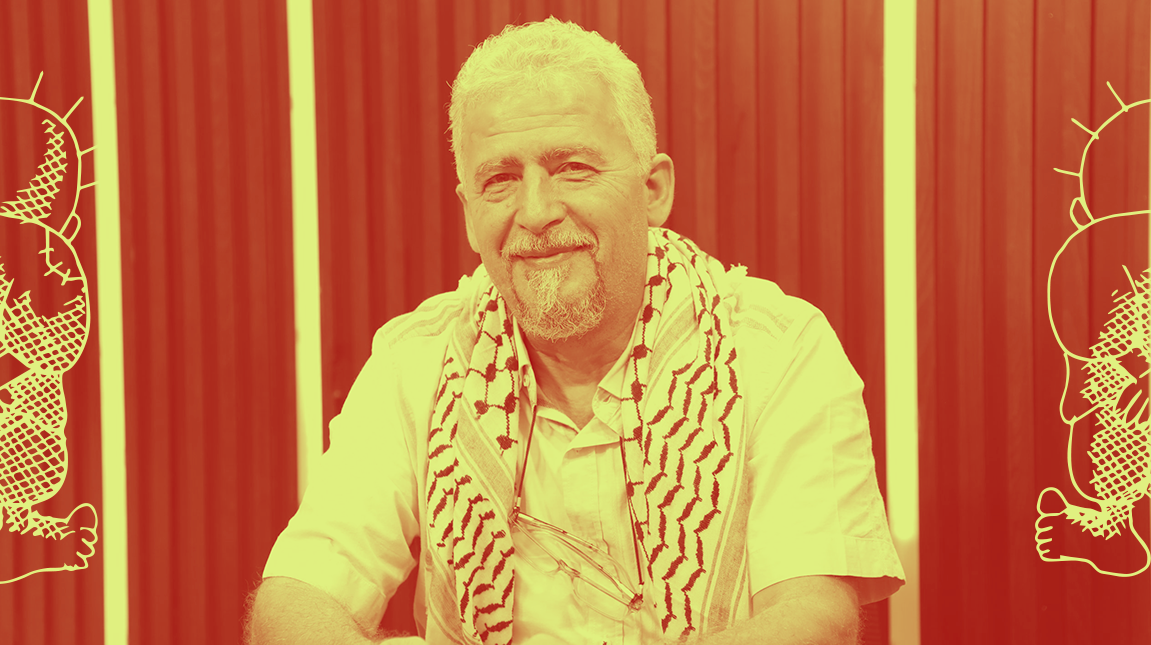
Anwar Yassine is a member of the Central Committee of the Lebanese Communist Party. In 1987, fighting with the Lebanese National Resistance Front, he was wounded and captured after engagement with Israeli occupation forces on the western slopes of Mount Hermon. He spent the next 17 years inside Israeli prisons; first Ramla, then Ashkelon; where he became part of the organisational core of the Palestinian prisoners’ movement. What follows traces his capture and interrogation, the collective political life detained built inside Israeli gaols before the 1993 Oslo Accords, the fracture Oslo produced, and the repression facing Palestinian prisoners today under Israel’s National Security Minister, Itamar Ben-Gvir.
Wounded in the Struggle
Drawing on his personal experience and the suffering he endured following his 1987 operation in southern Lebanon, Anwar Yassine, who is intimately familiar with the depths of Zionist prisons, speaks from a real experience. The operation unfolded on the western slopes of Mount Hermon, where several Israeli officers and soldiers who had descended on the position by helicopter were killed.
We engaged for approximately 6 hours, and then I was hit and wounded during the clash. The following day, after around 14 hours, I was surrounded on the spot because withdrawal had become impossible, the occupation forces had taken control of the whole area where the fighting happened.
He was moved into an interrogation centre in northern Palestine, he believes near Kiryat Shmona. Three days later, with his wounds dangerously infected and his life at risk, he was transferred to a medical facility.
“As it appeared, they kept me alive not out of mercy or human feeling, but because they needed to know who these people were who had inflicted such heavy losses on this enemy.”
The wounds were stitched hastily, without proper treatment, and within less than an hour he was moved again, this time to a military police interrogation centre in a zone called al-Sarafand, between the cities of Lod and Ramla. He remained there for roughly 100 days, the harshest of it in the first month and a half.
For that stretch, Yassine had no knowledge of what had happened during the battle, or whether the resistance leadership even knew whether he had been captured or killed. His captors exploited the blackout:
The enemy used to exploit this, the blackout over my condition, over my location, over what had happened, and so it constantly resorted to brutality, because the Red Cross had not yet visited me. It practiced great brutality trying to extract confessions, trying to get something useful for retaliation, or for an assault on the party, or on resistance positions.
The International Committee of the Red Cross (ICRC) reached him only after 45 days, and even then his captors moved him to a different site beforehand so the location of the interrogation itself would not be disclosed. At that first ICRC meeting he described the torture and the inhumane and immoral practices used against him. The ICRC also brought him fragmentary news of his family, of the party, and clippings from Lebanese newspapers about the operation and its aftermath.
It was only then that Yassine understood the scale of what had provoked the brutality: the occupation had acknowledged losing 2 officers and 2 soldiers killed, with 5 wounded.
“So the brutal practices pointed to revenge and to criminality, a response to the deep wound this occupying enemy suffered in that battle.”
The approach then shifted from raw violence toward inducement mixed with threats, of death, of being released into a minefield, of being shut in a room full of rabid dogs or feral cats. He reads these as attempts to break his will, attempts that failed because his conviction in resistance predated his capture. He had grown up in south Lebanon under occupation and had watched, first-hand, the routine humiliation of his own community:
I saw with my own eyes the crimes of this enemy, its practices, its degradation of the sons of my people in the south, how it would herd young men, older men, elders, and humiliate them in interrogation centres. My own father was among them, summoned more than once, and they would detain them for 8 or 9 hours under the sun. Then one of the guards would say the officer was busy today, or his aunt was sick and he’d gone to visit her, so come back tomorrow.
This, he says, is what shaped and developed the idea of resistance and of refusing submission to the occupier’s will, the culture that led him, eventually, into capture, and into a resignation about the odds of surviving it.
“Many might view martyrdom in such instances as an act of heroism; yet for others—myself included—the struggle to stay alive holds greater significance, for we have always striven, and continue to strive, to liberate our homeland and people from occupation, and because we reject the death imposed by that occupation.”
He emerged from the 100 days without breaking, a fact he says was confirmed by his own jailers. On his last day of interrogation, the intelligence officer told him: we will meet again in other arenas, and you will regret not having done yourself a service.
6 months of pre-trial detention followed, and then sentencing: 30 years, reached across roughly six court sessions. At his first appearance, in a military court in occupied Lod, Yassine refused to stand when the judges entered, a refusal he maintained for the rest of the proceedings, each time provoking a struggle that ended with him removed to a holding cell while the trial continued without him. He attended only the opening session, which he did not stand for, and the final sentencing session, under an arrangement negotiated between his court-appointed lawyer and the judges by which he would walk directly from the holding cell to stand facing the bench, rather than sit and wait in the courtroom.
The lawyer, an Arab lawyer appointed by the court, argued that Yassine had been captured on Lebanese soil and so could not be tried under ordinary Israeli law without a special statute. Yassine later learned that the lawyer was trusted by Israeli intelligence with access to the secret files of Palestinians held under administrative detention; the only Arab lawyer granted that access; which he reads as a mark of dependence on the Israeli courts and security services. Even so, the argument reduced the sentence from 4 consecutive life terms to a fixed ‘life’ term of 30 years, over the initial objection of the prosecutor (an intelligence officer acting in that role), before the three judges settled the matter after roughly half an hour of dispute.
I had expected a life sentence for each of the officers and soldiers killed, 4 dead, so 4 life sentences, with a minimum of 20 years for each of the wounded, 5 wounded, so 100 years on top. It could have come to something like 500 years. But because the terms of my capture were on Lebanese soil, as the lawyer argued, drawing on the legal texts inside the Zionist entity, they issued an exceptional ruling for my trial and this sentence, even though it is they who should stand trial, since it is they who committed the aggression, who entered my land, who destroyed my country and killed my people in south Lebanon, and still do to this day. But this is the arrogant logic of force.
From Ramla he was transferred to Ashkelon prison, and his 17 years inside the prisoners’ movement began.
Building the cellblock: the prisoners’ movement before Oslo
The prisoners’ movement took shape inside the legal architecture Israel inherited from British Mandate rule – the same emergency laws, in substance, that governed Palestine in the 1940s. Despite that inheritance, the movement turned fortresses like Ashkelon and Nafha into what Yassine elsewhere calls political schools.
Yassine begins with the point about inheritance directly:
The Zionist enemy relies heavily on what it inherited from British colonial rule over Palestine, laws, and even the old prison buildings themselves. Ashkelon prison, for instance, was barracks for soldiers and stables for horses, a depot for the British army, and it was converted into a detention facility, a prison for Palestinian prisoners. From the late 1960s it was turned into a security prison, a prison for political prisoners and fighters.
In the early period, he says, there was friction between prisoners held on ordinary criminal and civil charges and the security prisoners. It did not last long, because the resistance fighters began organising their lives inside captivity in ways sharply different from how criminal prisoners lived, friction that, in part, the prisoners themselves cultivated deliberately, until the criminal and security wings were separated into different blocks and sections. That separation was the first step, clearing the way for a more organised, more coordinated life inside the cells.
The possibility of establishing a self-contained organization within the prison to mobilize the prisoners during that period was slim; indeed, virtually non-existent. The net of arrest was wide enough to catch people with no real connection to the national cause, whose fragile sense of belonging and fragile political consciousness made them liable to fall into the hands of Israeli intelligence and become informants inside the cellblocks, reporting to the jailer on what happened inside and on who was active in organising escalatory steps against the prison administration to win more rights and a less brutal existence.
Until roughly 1972 – 1973, prison conditions included what Yassine calls ‘economic centres’ the jailer built inside the prisons; workshops, laundries, a form of production resembling tank-cover and tent-fabric work; with prisoners put to work in exchange for trivial rewards, such as 3 cigarettes a day, a form of what he calls extortion. The hard core of the prisoners’ movement that had begun forming recognised this for what it was: free forced labour serving the jailer. That recognition produced a strike refusing to carry out any work inside the prison at all.
“By the strike of 1972 or 1973, prisoners abstained from this work completely, and this step too was a qualitative leap in the prisoners’ lives.”
From there the hard core expanded, and organisation began to follow factional lines; Fatah, the Popular Front, the Democratic Front, the Palestine People’s Party, alongside separate religious and Islamic groupings. Cellblocks gradually sorted themselves along these lines, with a number of shared blocks that could not be closed off to a single faction, a cell holding between 8 and 14 prisoners might house a mixed room shared across organisations.
The movement developed further with the creation of a unified national leadership inside the prison, a joint committee in which every faction with more than seven members inside a given prison held one representative. This committee negotiated the terms of prisoners’ daily life and dealt with the prison administration through a single, agreed representative of the prisoner body. For a long stretch, Fatah, as by far the largest faction on the ground, making up between 40 and 45 per cent of prisoners in the pre-Oslo period, held that general representative position, chosen by the prisoners themselves to manage the affairs of the detention.
This organised life so that there wasn’t constant friction between the prisoners and the jailer directly. There is a national committee that runs the detainees’ affairs in confronting the jailer, and that also draws up the plans for confrontation; open-ended hunger strikes, tactical strikes, sit-ins in the prison yards, and acts of rebellion. These were the steps that raised the tension and sharpened the conflict with the jailer, whenever the jailer tried to impose a policy that served its own interests but struck at the prisoners’ dignity and their struggle inside the prison.
That collective discipline let the prisoners’ movement drag out confrontations and exhaust the jailer over time. Prison staff, Yassine notes, were denied leave to see their families while tensions in their prison ran high – leverage that the movement used to force a softening of punitive measures.
The prison movement didn’t just struggle for improved conditions, but for the dignity of visiting families. A given officer’s mood could determine what services were brought in for prisoners, and whether visiting relatives would be subjected to degrading searches. Firm, collective positions were required to secure basic respect for visiting families, a struggle waged continuously, accumulating gains in prisoners’ living conditions right up to Oslo, in 1993.
The strongest of these confrontations, Yassine says, was an 18-day strike in 1992.
We forced the jailer to concede the right to complete a university education and sit secondary-school exams inside the prison, and to bring in things related to study; writing boards, fans to ventilate the cells. Also an electric heater to warm food inside the cell, which had been forbidden before. So the 1992 strike achieved a set of gains for the prisoners’ movement, including better television channels, we went from around 3 or 4 channels to more than 12, half of them Israeli, but the other half Arabic channels, which let us follow some news from across the Arab world.
He describes the period from roughly 1987 to 1993 as the strongest in the prisoners’ movement’s history, in terms of its weight, its strength and its influence on the street, because it coincided with the Palestinian people’s First Intifada of 1987. That uprising fed the prisoners’ movement with large numbers of enthusiastic, driven young fighters ready for sacrifice, after long years of Israeli military rule and policy in the West Bank and Gaza. The consciousness and youthful energy that arrived with the Intifada fused with the organisational experience of veteran prisoners who had lived long years of captivity before it; among them, he says, men whose time inside the prison spanned his own entire life outside it.
One of the heroes, the martyr Omar al-Qasem, had been a prisoner since 1968. I was 4 months old when the martyr Omar al-Qasem was arrested. He was martyred inside the prison after 21 years of captivity, as a result of medical negligence, perhaps a malignant illness planted in his body, because he was an exceptional figure among the most distinguished, with a great imprint on the prisoners’ movement. But his influence carried on, because a number of the prisoners who shared long stretches of his captivity remained inside, and they carried his life’s experience, his struggle, and his story to the new prisoners, fusing them into the movement in whatever organisational way best fit, whether recruiting them politically and organisationally inside the prison, or otherwise drawing them into the prisoners’ movement.
Oslo’s fracture
Prisoners like Marwan Barghouti, Ahmad Sa’adat and Khalida Jarrar, and others held across the period before and after Oslo, are often framed purely as a humanitarian matter. Yassine weighs that framing against what he sees as Israel’s actual target: the political leadership capable of sustaining a Palestinian national project and a political resistance to the present order.
Yassine answers by tracing the effect of Oslo on the prisoners’ movement directly.
There is no doubt, as my comrade said, that the political division inside the Palestinian street over the Palestinian cause, between Oslo, and the forces that supported Oslo, and the resistance forces that saw in that choice a suicidal option, an option involving major concessions in the enemy’s favour, an enemy that would exploit those concessions to impose still more concessions rather than grant the Palestinian people their right to establish a state and a political entity that ends this historic conflict with the enemy.
He describes the occupation’s racist, expansionist character, backed by imperialism and serving as what he calls a spearhead of the imperialist project, an instrument of tension rather than stability or development in the region. That structure let Israel extract concession after concession from the Palestinian side, which is what much of the resistance camp on the Palestinian political scene rejected, and, in his account, what has kept the division sharp and unresolved to this day.
That policy, he argues, has not spared its own beneficiaries from the occupation’s practices. He points to the West Bank; nominally under the authority of the Oslo-era Palestinian Authority; where settlers and Israeli soldiers commit what he calls crimes no less severe than those inflicted on Gaza, even without the pretext used to justify the Gaza war (that armed resistance had raised a direct military challenge there).
In the West Bank, despite the absence of that kind of broad resistance force, and despite a Palestinian Authority exercising authority over a wide area, with more than 60,000 Palestinian Authority police, it hasn’t been able to stop even a single settler committing a crime, while tens, hundreds, thousands of crimes are committed against our people in the West Bank.
This is why, Yassine says, the movement treats the current escalation under National Security Minister Itamar Ben-Gvir as a consequence, not a cause: a result of the prisoners’ movement’s own weakening, and of the occupation’s success in dividing the Palestinian political project between supporters and opponents of Oslo, a division that reproduced itself inside the prisons, between prisoners who backed Oslo and those who rejected it. That internal split, he argues, is what has made it difficult for the jailer’s practices to be deterred, since deterrence has always depended on a collective will exercised jointly by prisoners across factional lines, which in turn depends on unity in the Palestinian street outside.
If the prisoners’ movement is united, or conversely if the Palestinian street is united, then naturally the national prisoners’ movement will be united. But the division in the Palestinian street, in official Palestinian politics, reflected itself as division inside the prisoners’ movement, and so the jailer began practising this criminality, this psychological and physical torture, against the leaders, above all the leaders and influential figures inside the prison, among them comrade Ahmad Sa’adat, the leader Marwan Barghouti, and Abbas al-Sayed, and many other leaders the jailer considers influential, whose word carries weight among the prisoners. But the division of the prisoners’ movement has made the response to these practices divided against itself, not unified.
The prisoners’ movement made one attempt to reverse this, he says, sending a unity letter to the wider Palestinian political scene in in the period between 2010 and 2011, but because the movement itself was still divided from within, the letter could not do the work of forcing outside political forces to unify, since the Palestinian scene had by then split into two positions that, in his view, cannot be reconciled: a camp betting on diplomacy and negotiation with what he calls a criminal, racist, occupying enemy backed by colonial and US imperial power, and a camp that recognises the futility of that bet. Unity, he argues, is possible only under the banner of resistance and a resistance culture spanning the full geography of occupied Palestine, which, he says, is precisely what has proven impossible to achieve, slogans and periodic meetings notwithstanding, because the Palestinian liberation project itself remains divided against itself. Working out how to end that division and restore a unified resistance front, in his view, is now an urgent subject of study, one in which Palestinian prisoners, he suggests, could play a significant role in redrawing a unified Palestinian political line.
After 7 October: the law of the cage
Since 7 October 2023, Israel has ratified death penalty legislation targeting Palestinian prisoners, and applied a new legal category to detainees from Gaza as “unlawful combatants”, a framework that recognises no other category for them under Israeli law. Reports since describe a scale of torture, and a logic behind it, that Yassine calls at best animalistic.
Yassine reads the “unlawful combatant” designation as a deliberate manoeuvre, an attempt to divide prisoners into categories, security prisoners against unlawful combatants, to lend a veneer of legality and legitimacy to how they are then distributed and treated.
Its practices on the ground respect neither legal nor humane restraints, nor anything else. Whoever hears the occupation call them ‘combatants’ might think that, if they were lawful combatants, it would abide by the Geneva Convention in how it deals with them, this is a kind of deception. It does not recognise the legitimacy of the Palestinian resistance fighter, or his right to defend his right to a free and dignified life and to confront the occupation, and so it practises this brutality to kill the spirit of resistance and of defiance that the prisoner inside the prisons, and the resister in the street, child, young man, older man, woman and girl alike, represents when they reject this occupation. Through its practices, the occupier tries to deter that will and empty it of its content of struggle, in order to impose its domination and erase the existence of this people, the rightful owner of this land, this history, this homeland.
He extends the same logic to how Israel has fought the war in Gaza, dividing the campaign, he argues, into what looked like three separate battles (north, then the centre of the Strip, then the south, bargaining over entry into Rafah) purely to ease its own task and to blunt, or dilute, international reaction by negotiating piecemeal, as if solving ‘the problem in the north’ would resolve the whole matter and give the occupier what it wanted. In fact, he says, it is one crime, one war against the Palestinian people across the whole of the Strip, control has since spread from the north to the centre, and then the south, until roughly 70 per cent of the Gaza Strip now sits under occupation, with more than 85 per cent of buildings and homes destroyed entirely, and less than 30 per cent of Gaza’s population left besieged in a narrow area.
So we should not be fooled by the Zionist enemy’s attempt to play with terms and labels, because its practices on the ground give no weight whatsoever to any law, or to any humanitarian, legal or judicial norm. It is an enemy trying, through a policy of force and the escalating imposition of domination and power, to bring the Palestinian people to their knees, and all these practices are not merely individual punishment for particular conduct, for this or that detainee’s or leader’s behaviour, but an attempt to break the will of resistance and the will of defiance itself.
That will, he argues, does not break under pressure, it hardens, exposing the occupation’s true face more starkly the harder it presses, which is why he insists the movement cannot leave its prisoners and its fighters inside the prisons without a response at the level of the resistance itself: the prisoners’ cause, their release and their protection, and reducing the Zionist criminality practised against them, has to remain one of the standing headlines in any confrontation with this enemy, until release comes, whether through prisoner-exchange operations, or through mounting exhaustion of the occupier and international and Arab demand that this cause stay present, so as to force the release of prisoners with their dignity, their humanity and their lives intact.
Not humanitarian cases, but political prisoners
The campaign of the International Peoples’ Assembly (IPA) has raised Palestinians’ right to political life, a right routinely denied to former prisoners. Prisoners Yassine has met are unable to voice their political positions even after release: those inside the West Bank or Gaza risk rearrest if they do; those released into exile, in Egypt or elsewhere, find the host country itself unwilling to let them speak on Palestinian political affairs.
Yassine’s answer treats the two as inseparable.
This enemy, as we said, always tries to present any opposing position to its behaviour and its racist policy as terrorism, as criminality, and so it rejects even a position that simply rejects the existence of the occupation, or exposes its true face. It is impossible to bet that the Zionist enemy and the Zionist occupation would allow the resistance, or political forces, or the sons of our Palestinian people, to express a political opinion opposed to the occupation and rejecting its existence, because it fears that seed might, little by little, produce change at the international level, even absent any military action against the occupation. It only grows more racist and more vicious toward our Palestinian people.
He locates this in periods when Palestinians had no capacity for armed resistance at all, arguing that occupation practices have always worked to erase the Palestinian cause and the people’s right to a free and dignified life, and to voice their dreams, their pain, their hopes and their own political project. This, he says, is an expansionist occupation that refuses even to acknowledge that a Palestinian people exists, pointing to Netanyahu and his government’s open statements ruling out a Palestinian state, statements matched, in his account, by facts on the ground: further tightening around the Palestinians remaining in Gaza, and, in the West Bank, continued settlement construction. Netanyahu, he notes, has boasted of building more than 104 settlements during his time in office.
That means a wide area of West Bank land has come under the domination and authority of these gangs and settlers, which by necessity requires a response, because this is naturally meant to prevent a Palestinian state, as Netanyahu himself says, and to foreclose any geographic and demographic unity that a Palestinian state would need, whether within the West Bank itself or between the West Bank and the Gaza. So it tries to plant contiguous, interlocking settlement outposts, with their own dedicated roads, to seize new and large areas of West Bank land and besiege our people in the camps, the towns and the villages as if in besieged ghettos – while leaving the field wide open for gangs of settlers to spread corruption and criminality wherever they go, and to keep expanding these settlements.
For Yassine, this rules out any accommodation with the occupier short of resistance itself – a language of resistance, of holding to rights, and of outright rejection of the occupation’s existence.
The world today looks at the Palestinian cause as a cause with its own symbolism in recovering rights, recovering this people’s freedom, recovering its dignity and its right, on its own land, to establish its independent state with Jerusalem as its capital, and in rejecting this policy – a policy that no longer only frightens our Palestinian people into the necessity of resisting it, but has begun to frighten the world, and every free person in the world. Because if a policy like this, and this criminality, this genocide, succeeds across the whole of the Palestinian homeland and against our Palestinian people, it means it will not stop there – it will spread to other places, and if it succeeds in one place, it will naturally extend elsewhere. That is what every free person rejects, whether in our Arab nation or across the world, and that is what has to unite efforts, to unify the vision needed to confront this occupation, backed by global imperialism, above all by US imperialism. This demands patient, long work, and a unified will drawing together every effort that understands the danger of submitting to the will of the occupier, to this arrogance and this criminality – because submission to it means annihilation, and death. That is not the way of the free, in our nation or in the world.