Seven Fronts: The Sahel’s Fight for Sovereignty
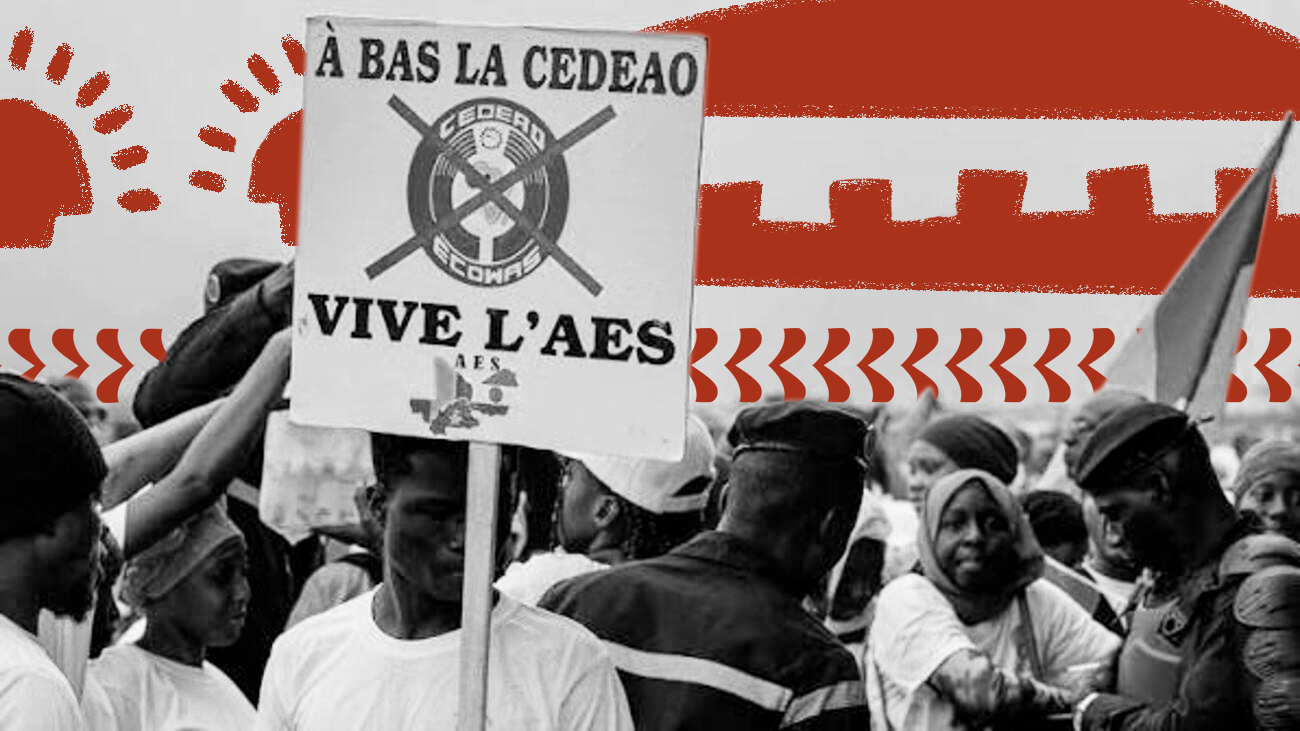
On 24 August 2026, 45 deputies took their seats in Niamey’s Mahatma Gandhi conference centre for the inaugural session of the Confederal Parliament of the Alliance of Sahel States (AES), 15 each from Mali, Burkina Faso and Niger. It is the last major piece of an institutional architecture that already runs to a flag, a common biometric passport, a confederal television network and, on paper, a 500 billion CFA franc development bank. Two hundred kilometres to the north, in Agadez, some 1,800 tonnes of Nigerien uranium sit in storage, nationalised from the French nuclear group Orano in June 2025 and, 14 months later, still unsold, blocked by an international arbitration order Niamey has threatened but not yet defied.
“Independence came to 53 countries with 53 flags, so it was sovereignty of flags”, Youlouka Damiba, general secretary l of Burkina Faso’s International Committee for the Thomas Sankara Memorial, told the Fourth Continental Assembly of ALBA Movimientos, in Havana in early August 2026. He was describing a continent which still runs on inherited currency controls, foreign-framed armies and raw-material export economies. The AES’s state apparatus is completing itself faster than its sovereignty claims are delivering. That gap is best measured against the seven fronts Damiba set out as still to be won: fiscal and monetary sovereignty, control of the narrative, cultural and spiritual transformation, the confrontation with armed political Islam, the military struggle for territory, productive transformation, and an independent foreign policy. That framework structures what follows.
Alongside these Damiba lists the additional external threats of proxy wars, sanctions, blockades, lawfare, and an information war waged specifically against ‘the socialist model in the Sahel.’ He also highlights internal threats including: bureaucracy, corruption, a ‘state bourgeoisie’, and the fatigue of a population asked for sustained sacrifice. Damiba’s speech says a great deal about the situation the AES is in today, not only the external forces working against the alliance, but how the states themselves are choosing to handle the problems they face internally.
None of these seven fronts is new. Each has a Sahelian precedent going back six decades. Each was reversed by a coalition of external pressure and an internal faction willing to trade sovereignty for power. That history, not the AES’s own communiqués, is the material against which its current claims have to be tested. Mali’s first president, Modibo Keïta, broke from the CFA franc zone in July 1962, telling his party’s central committee the new Malian franc was ‘a declaration of political and economic war’ against France. Paris blocked Mali’s return to the regional monetary union for 17 years; a 1967 agreement restored French oversight, a coup removed Keïta in 1968, and Mali rejoined the CFA zone in July 1984.
Fiscal sovereignty also cost Hamani Diori, the first President of Niger, his government. He was overthrown in April 1974 while renegotiating French uranium terms at Arlit, where the state was then getting barely a third of the profit projected. Niger’s independence movement supplies an earlier case still. Djibo Bakary’s Sawaba party campaigned for full independence rather than the limited autonomy France offered in 1958. Nine days before the referendum on this independence, the colonial administrator Jean Colombani removed Bakary from power outright, in what is now described as Africa’s first modern coup d’état. Bakary’s Sawaba party later fought its own guerrilla campaign from exile in 1964 and 1965, with Chinese backing. French-backed repression under Diori’s government crushed it. Captured fighters were tortured and several were executed before assembled crowds.
This anti-colonial resistance is a continuous thread. In Upper Volta, Thomas Sankara’s government pursued Bakary’s continental ambitions through the Non-Aligned Movement, addressing the UN General Assembly in 1984 and 180 international delegations on Cuba’s and Nicaragua’s behalf in 1986, before it too was ended by a coup in October 1987. In May 2024, Niger’s current government created an official medal, the Sarauniya Mangou, for sacrifice in the cause of sovereignty, naming it for the nineteenth-century queen.
Fourteen months after nationalising Orano’s Somaïr uranium subsidiary, Niger’s government has sold none of its stockpile. It has been locked by an international arbitration order kept alive by Orano’s own litigation showing the kind of legal leverage a dispossessed French concessionaire can still bring to bear even after losing the asset itself.
Burkina Faso, Africa’s fourth-largest gold producer, has fared better on paper, transferring five mines from Endeavour Mining and Lilium to the state company SOPAMIB in June 2026 and benefiting from a 27 per cent gold-price rise. Mali forced a $438 million settlement from Barrick Gold in 2025 under its revised mining code, though industrial output still fell 23 per cent in 2024. The confederation’s own investment bank, BCID, has made no disbursements eight months after its December 2025 launch, and Mali ratified a new $33 million World Bank electricity loan the same week its own mining-infrastructure fund reported mobilising over 109 billion CFA francs. Sovereignty asserted at the level of ownership has not yet become sovereignty at the level of revenue.
Productive transformation is where the current governments have most explicitly tried to inherit Sankara’s legacy rather than only invoke it. Sankara’s government remains the clearest historical benchmark for what state-led transformation actually delivered: ten million trees planted under a fifteen-month development programme; national literacy raised from 12 to 22 per cent in two years; and cereal production pushed from 1.1 million to 1.6 million tonnes between 1983 and 1987, taking the country’s food coverage ratio to a peak of 129 per cent without imports (Thomas Sankara Speaks: The Burkina Faso Revolution, 1983–87).
Before the 1968 coup ended it, Keïta’s government in Mali pursued the same goal through Sovietand Chinese-financed infrastructure including mining research, the Modibo Keïta Stadium and interest-free loans focused on the Office du Niger. Traoré’s government has revived the same register directly, distributing 400 tractors and motorised pumps to rural cooperatives in 2025: continuity of method, not yet of scale. The confederal effort is better resourced but earlier in its cycle. The AES energy and mining ministers who met for the first time in August 2026 declared resources “the bedrock of our social justice” but produced no harmonised code. Niger signed a $1.9 billion refinery deal with Canada’s Zimar Group in August that is, so far, an announcement and nothing more.
Controlling the resources has come with an equally deliberate attempt to control the story told about them. The second front that Damiba mentioned, controlling and shaping the narrative on the process, is the oldest of all, run for eight decades from Paris. France’s monetary Treasury doubled as the region’s information gatekeeper, supervising the committees that produce the franc zone’s own official economic analysis and, through its long entanglement with outlets like Jeune Afrique, its political coverage too. The AES’s answer has been to build parallel infrastructure of its own. AES Television launched in Bamako in December 2025 with all three heads of state present, explicitly framed as countering ”disinformation” and building “shared media sovereignty.” Burkina Faso’s legislature ratified confederal radio and a second television channel in 2026. For the first time since independence, the story of the Sahel is being told from Bamako, Ouagadougou and Niamey, not dictated from Paris.
Where the AES states have tried to give their sovereignty claim a legitimacy older than 2023, they have turned to history. Mali’s own planning documents ground economic sovereignty explicitly in precolonial governance – citing the 1236 Manden Charter, Massina Empire legal codes and the Timbuktu manuscript tradition and on the argument that endogenous development requires endogenous legitimacy, not only endogenous capital. That argument has since acquired institutions: the three culture ministers signed a common AES cultural policy in Ségou in February 2025, and Mali’s 2026-27 education reform makes the case for language explicitly: “no nation can build durable intellectual, scientific and cultural sovereignty without giving a central place to its languages”. What none of this yet reaches is spiritual transformation specifically, as distinct from cultural or linguistic policy. Nothing in the AES states’ own documents or in reporting on them treats religious or traditional-spiritual practice as its own dimension of the sovereignty project, and that is a genuine gap in what has actually been built, not only in what has been written about it.
The legitimacy claim the AES governments did not choose to contest with is the armed, religiously framed counter-revolution occupying their own territory. The insurgency is best explained by what the state stopped doing, not by theology alone. Rebuilding that rural capacity is exactly what AES’s productive-transformation front is now doing: distributing the machines to rural cooperatives. Structural adjustment from the 1980s cut the veterinary services, agricultural extension and grain reserves that had sustained rural livelihoods. Katibat Macina (founded by Amadou Kouffa, and a founding member of JNIM), formed in central Mali in 2015, filled the resulting vacuum by abolishing grazing fees outright, material relief that explains recruitment more than doctrine.
The jihadist movement is not doctrinally uniform: JNIM’s (Jama’a Nusrat ul-Islam wa al-Muslimin, one of the most active jihadist armed groups in Mali today) 2019 split with the Islamic State Greater Sahara turned partly on ISGS’s call for land collectivisation, a direct challenge to the class position of pastoral chiefs JNIM’s own constituent groups had preserved. And where dispossession has instead been channelled into ethnic violence, as with the Dogon militia Dan Na Ambassagou’s killing of roughly 160 Fulani civilians at Ogossagou, central Mali in 2019, the target has been the wrong one: Fulani communities, not the pastoral and administrative elites doing the dispossessing. JNIM is, in any case, openly hostile to the AES project: in a December 2023 video, its leader Iyad Ag Ghaly urged supporters to fight the ‘treacherous governments’ of Mali, Niger and Burkina Faso alongside their Russian allies, borrowing anti-imperialist language for a project defending the same elites AES’s own reforms threaten. That is not a rival sovereignty claim; it is dispossession defended as resistance, pressed over the same population the AES is trying to win.
On the ground, JNIM and FLA (Azawad Liberation Front) forces remain able to inflict real losses. An offensive took the northern town of Kidal within 24 hours in April 2026, and Mali’s defence minister General Sadio Camara was killed the same day. This is a genuinely contested front, not a settled one. Domestically, Burkina Faso’s VDP (Volunteers for the Defense of the Homeland) and Niger’s newly mobilised Kourfey-canton “volunteers” extend the state’s reach directly into local communities: this the kind of popular defence that the leaders of the AES are speaking about.
Sovereign diplomacy is the front where AES has built the widest network of partners any Sahelian government has assembled since independence, working through channels France or ECOWAS never sanctioned. This month’s release of 82 Malian soldiers held by the FLA was brokered through Morocco, Qatar, Algeria, The Republic of Congo, Togo and Khalifa Haftar’s Libya, a genuinely diversified set of relationships built in under three years. Mali’s July 2026 normalisation with Algeria extended the same logic reopening a channel over the Anéfis corridor. Foreign minister Abdoulaye Diop told an August security conference in Kigali that the AES represents ‘authentically African leadership’: the same claim to independent diplomacy Bakary and Sankara made before him, now backed by a wider working network than either had.
Each of the historical ruptures traced here ended the same way: through external pressure combined with an internal actor willing to trade sovereignty for power. What is happening today in the AES is a real, if incomplete, rupture with the past. Institutions are being built and resource control, though not fully delivering, is being asserted: Resource revenue that once flowed through French concessionaires now sits, unevenly, with SOPAMIB, SOPAMIN and the mining funds themselves; The Russian-backed gold refinery and the Chinese lithium project at Goulamina answer to a different logic of accumulation than Orano and Endeavour Mining did. This is the material substance of the sovereignty claim. It is real, even where, as with Niger’s unsold uranium, it has not yet converted into revenue.
What Damiba’s seven fronts describe is not a single reform but an attempt, barely three years old, to rebuild sovereignty across every dimension of life at once: currency, mining, culture, faith, food and defence together, against an enemy still working to reverse it. The AES is reaching for what Keïta, Bakary and Sankara reached for and lost. This time with more territory, more allies, and a confederation built from three states rather than one government standing alone. The popular power this project claims as its foundation, the same citizen mobilisation Damiba described in Havana, is what has carried it this far, and what it is counting on to carry it further.