Manifesto of the ALBA Movimientos Fidel Castro Internationalist Youth Brigade
26 August 2026, Caracas, Venezuela.
We are Guevara’s children,
children of Chávez and Fidel,
fighting for a liberated homeland,
united in struggle until victory.
Because Chávez is still here,
the people have not surrendered.
For the Patria Grande — our Great Homeland — and liberation.
Here stands the youth,
fighting capital.
Together we will free Maduro and Cilia.
(ALBA Movimientos Fidel Castro Internationalist Youth Brigade)
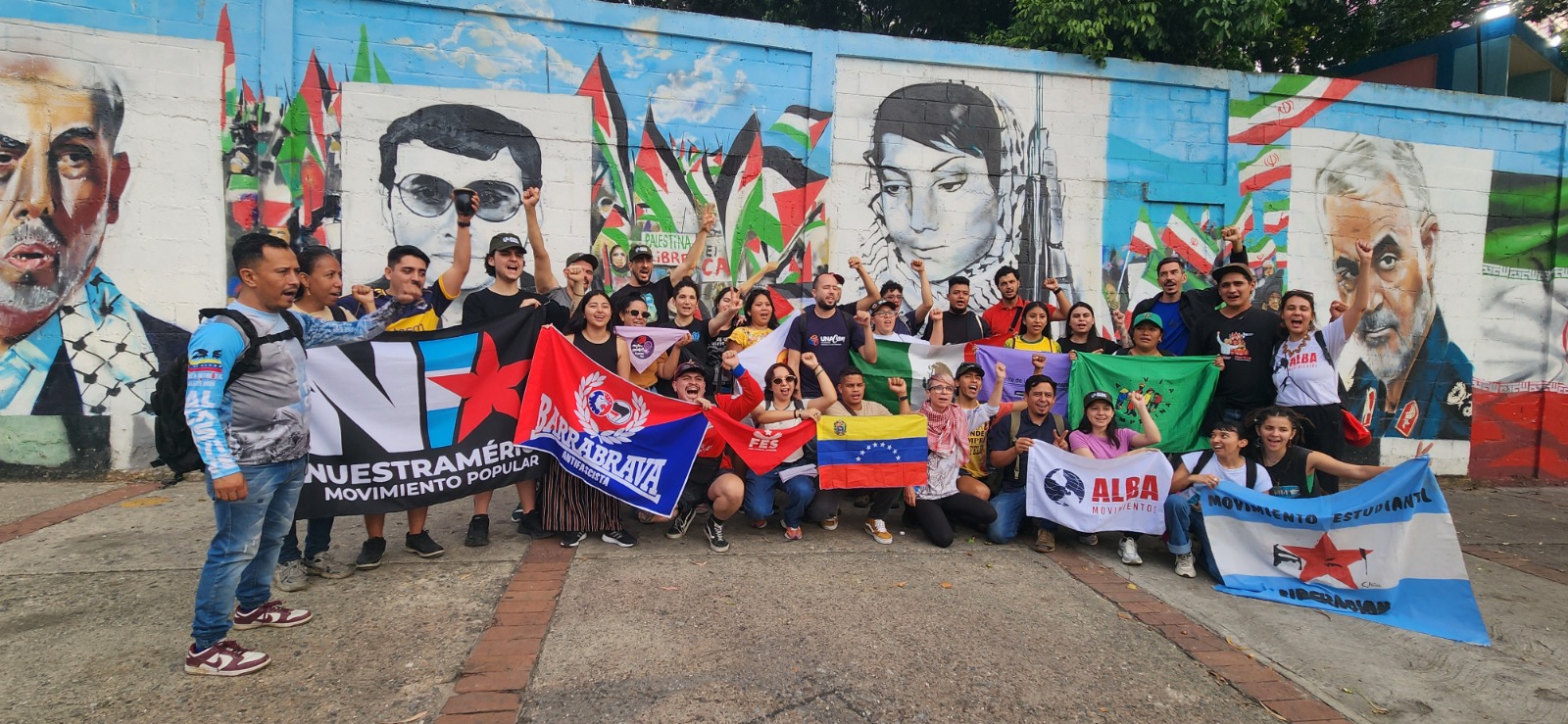
We are the ALBA Movimientos Fidel Castro Internationalist Youth Brigade: 30 young people from 10 countries who, over the course of 11 days, took part in a process of political education and solidarity in Caracas, Venezuela, at the Robinsonian National School. We are young militants from Panama, Brazil, Mexico, Honduras, El Salvador, Chile, Colombia, Guatemala, Argentina, and Venezuela. We belong to 32 different organisations, including urban movements, peasant movements, unions, youth and student movements, women’s movements, and political parties. With great pride, we named our brigade in honour of Fidel Castro, Commander in Chief of the Cuban Revolution.
More than 20 years ago, the embrace between Fidel Castro and Hugo Chávez opened a new chapter of unity among the peoples of Latin America and the Caribbean. Today, in the year of Fidel’s centenary, and amid a conjuncture that is increasingly aggressive and voracious towards our countries, keeping this history alive is essential as we think through the unity needed to confront the common enemy of our continent: imperialism.
As young militants living in the year of Fidel’s centenary and the bicentenary of the Amphictyonic Congress of Panama — the 1826 congress convened by Simón Bolívar to advance the unity of the newly independent republics of Our America — we take on both a responsibility and a historic task. Reclaiming our history, the history of resistance in our region, of our organisations, and of our leaders gives us strength and, above all, offers us a horizon: socialism.
Across our continent, we are witnessing the rise of far-right governments and forces: José Antonio Kast in Chile, Javier Milei in Argentina, Abelardo de la Espriella in Colombia, Rodrigo Paz in Bolivia, Keiko Fujimori in Peru, Daniel Noboa in Ecuador, and Nayib Bukele in El Salvador. In Brazil, Jair Bolsonaro, despite being imprisoned, continues to mobilise his base, making the coming elections decisive for our continent. Keeping Luiz Inácio Lula da Silva in government, alongside defending the government of Claudia Sheinbaum in Mexico, is of great importance for our struggles and for the balance of forces in the region.
The decline of empire does not come without consequences. Violence is intensifying through the growing militarisation of our continent — a violence that targets Black bodies, women’s bodies, and young bodies. The plunder of our natural resources continues unabated and remains one of the driving forces behind the rise of far-right governments.
The technological dispute now under way, together with the energy crisis produced by wars and conflicts in other regions, has made our continent a target of empire. In this context, imperialism seeks to revive its history and reorganise its plans for domination, as we see in the return of the Monroe Doctrine as an organising principle of US policy towards the region.
Colonial projects remain in place, especially in the Caribbean. This is the case of Puerto Rico, which remains under US colonial domination, as well as Haiti, where a permanent crisis has been sustained through years of exploitation, plunder, and military interference.
In Venezuela, one of the world’s largest oil-producing countries, imperialism spent years trying to overthrow the Bolivarian Revolution through coups, blockades, attempts to generate political crises, and the questioning of elections. Having failed to bring it down, imperialism decided it was time to attack. On 3 January 2026, they entered the country using their most advanced weaponry, killing Venezuelan combatants and 32 Cuban combatants, sowing panic and pain among the population, and kidnapping Nicolás Maduro, Constitutional President of the Bolivarian Republic of Venezuela, and Cilia Flores, First Combatant, First Lady, and Deputy of the National Assembly. They did not merely kidnap two people; they kidnapped an entire country, and with it, our continent.
In Cuba, after 60 years of a criminal economic and energy blockade, the brave Cuban people — who have always lived with the difficulties imposed by imperialism — now face an increasingly desperate situation: the harshest moment of the blockade, marked by shortages of raw materials and basic goods on the island. Imperialism seeks to break Cuba silently, from within. It threatens Raúl Castro, historic leader of the Cuban Revolution, and seeks to create panic among the population.
Latin America and the Caribbean are rich in natural resources, which have long drawn the predatory gaze of empire. But ours is also a region of historic struggles, revolutions, and peoples who resist to the end. In other words, ours are peoples who threaten the current hegemony. This history of struggle, which imperialism tries to erase, is part of its political project of domination over our region. But they underestimate the power of resistance of peoples who know what they are fighting for and who know their historical mission.
Across the continent, our lives remain marked by neoliberalism, which presents individualistic ways of life as solutions to collective problems. Where the dominant logic is individualism, predation, and control, having revolutions in what empire considers its ‘backyard’ represents an unprecedented threat to the cannibals.
It is in this context of violence, constant aggression, and attempts at destabilisation that we came to learn from the Bolivarian Revolution. During these 11 days in Caracas, we studied, walked the streets, spoke with the people, and sought to understand reality from its most concrete and everyday dimensions. We studied popular and communal feminism, the history and present of the Bolivarian Revolution, and the history of ALBA Movimientos, anti-imperialism, and socialism. This history speaks to the broader history of struggle and resistance throughout Latin America and the Caribbean. We learned about the communes, the Venezuelan economy, the country’s history, and the organisational processes within the Bolivarian Revolution, together with those who build it every day.
We were received by Deputy Tania Díaz; the Partido Socialista Unido de Venezuela (United Socialist Party of Venezuela, PSUV), Venezuela’s governing socialist party; the Simón Bolívar Institute, a Venezuelan institution dedicated to international solidarity and anti-imperialist political education; the Ministry of Youth; and the youth of the party. We listened to these institutions and came to better understand the country’s current political projects, its forms of care and support for the population, and, above all, the support directed towards Venezuelan youth.
We paid tribute to the combatants who fell on 3 January. We spoke with those affected, heard their stories, and felt their pain. Together with comrades from the Partido Verde de Venezuela (Green Party of Venezuela), an ecological political organisation in Venezuela, we planted trees as a symbol of rebirth, cultivation, and renewal.
We walked through the communes of El Panal, 5 de Marzo, and the Ezequiel Zamora Communal Circuit. We listened and were moved by the stories the Venezuelan people told us about Commander Chávez and President Maduro: stories of collective construction, of advances made over the years through the strengthening of popular power, and of the attack of 3 January. We heard the people call for the return of their president and first lady.
We travelled to La Guaira, the state most affected by the earthquakes of 24 June 2026. We walked among the rubble and saw images we will carry with us forever. But we also saw a level of solidarity, action, and collective work unlike anything we had ever witnessed, from both the people and the government. We came to understand the power of rooting a political project in the transformation of human relations.
We spent three days in temporary camps in the Capital District and La Guaira: the Luis Hurtado Higuera Camp in El Junquito; the Narciso Gonell Camp in Catia La Mar; the Temporary Camp for Older Adults; and the Comprehensive Social Care Post in the state of La Guaira. We worked alongside the people. We helped in the kitchens, spoke with residents, and played with the children. We were able to feel and understand the material basis and concrete expression of a government project whose greatest strength lies in the territories and in the people who inhabit them. We came to better understand the attempted imperialist management of shelters and camps through NGOs, and we reject such acts. Popular sovereignty remains alive, even in a time of such pain. We are witnesses to this.
We brought medicines in our suitcases. We received supplies of antibiotics, corticosteroids, painkillers, medical materials, personal hygiene kits for women, powdered milk for children, diapers for adults and children, and emergency kits collected in our countries and delivered to the temporary shelters.
While imperialism seeks to revive its old methods and strategies, we affirm that we will not allow history to repeat itself: not the history of coups, plunder, attacks, massacres, and the degradation of our countries; not the history of exhausting our forces, our lives, our economies, and our societies.
The only history we will allow to repeat itself is the history of revolutions, struggles, guerrillas, solidarity brigades, and unity among peoples.
In light of all this, we declare that:
- We reaffirm the bonds of solidarity between our organisations and the Bolivarian Revolution, with the parties and organisations that make up the Venezuelan chapter of ALBA Movimientos, and with the youth of the country.
- We reaffirm our commitment to communicating the reality of the Venezuelan people and to combating the hegemonic discourse that seeks to weaken the Bolivarian Revolution.
- We reaffirm the unity between the Cuban and Venezuelan Revolutions, as well as our unwavering solidarity with these revolutions — our socialist beacons.
- We reaffirm our permanent solidarity campaigns with Haiti and Palestine.
- We reaffirm the ALBA Movimientos charter, approved at the IV Continental Assembly in Cuba in 2026, as well as the updated political work plan, the axes of work, and the tasks set for our organisations and for the youth of ALBA.
- We reaffirm the construction of new emancipatory political relations and of a popular feminism rooted in race and class.
- We reaffirm our commitment to the responsibilities entrusted to us as brigade members, and to carrying that commitment forward by reproducing the educational process we experienced here among the communes and camps, and by taking popular internationalism back to our countries, organisations, and territories.
- We reaffirm our commitment to the renewal of cadres in our organisations through the constant political education of our youth.
- We reaffirm the need for anti-imperialist continental unity, with socialism as our common goal and the only possible path to resist and combat decadent imperialism.
We will continue to carry forward the legacy of Chávez and Fidel. From the embrace that brought us together, we will continue to carry forward solidarity as concrete action.
We will continue to shoulder our responsibility: solidarity with the peoples of the world and the construction of socialism, until our entire continent is red. No one has surrendered here, and Chávez remains alive in the streets and in our hearts.
Participating organisations of the ALBA Fidel Castro Youth Brigade: Movimiento Estudiantil Liberación – Corriente Nuestra Patria, Movimiento Evita, OLP Resistir y Luchar, Sindicato Canillitas, NODAL, Nuestramerica Movimiento Popular, Movimiento Sin Tierra (MST), MODATIMA Wallmapu, Congreso de los Pueblos – Plataforma Estudiantil APELEAR, Fuerza Estudiantil Salvadoreña (FES), Frente Farabundo Martí Para la Liberación Nacional (FMLN) Comité de Reconstrucción y Desarrollo Económico Social de Comunidades de Suchitoto (CRC), Bloque de Resistencia y Rebeldía Popular, Centro de Estudios Schafik Handal, Comité de Unidad Campesina (CUC), Mujeres Socialistas de Honduras, Bases Unidas, Movimiento Estudiantil Revolucionario – Lorenzo Zelaya, Casa Tecmilco, Instituto Nacional de Formación Política de Morena, Suntracs.
Organisations of the Venezuelan chapter of ALBA Movimientos: Movimientos de Pobladores y Pobladoras (Movements of Settlers and Residents); Calistenia Cultural; La Minka; Movimiento Otro Beta (Another Beta Movement); La Otra Escuela (The Other School); Red de Trabajadores del Movimiento Somos Venezuela (Workers’ Network of the Somos Venezuela Movement); Frente Francisco de Miranda (Francisco de Miranda Front); Frente Patriótico Alexis Vive (Alexis Vive Patriotic Front); Cumbe Nacional Afrovenezolano (National Afro-Venezuelan Cumbe); Escuela de Cuadros (Cadre School); Partido Verde de Venezuela (Green Party of Venezuela); and Faldas-R, Movimiento Nacional de Amistad y Solidaridad Mutua Venezuela-Cuba.